Making Ends Meet: Unaffordable Housing

Last month, we showed just how difficult it is for working parents to afford to pay for child care and cover other living expenses. One of those other major living expenses that all workers must account for is the cost of housing and utilities.

Housing is considered affordable if it costs no more than 30 percent of a family’s income. For workers earning minimum wage, though, finding housing at 30 percent or less of their income can be impossible.

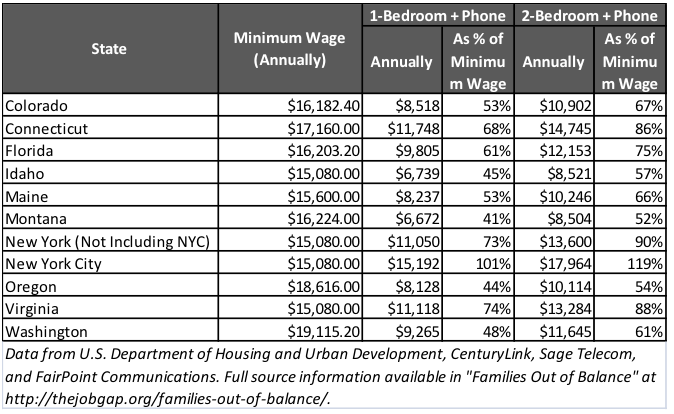
The cost of housing and utilities (including basic home phone service) for a one-bedroom apartment takes more than 50 percent of a full-time worker’s income at minimum wage in 6 of the 10 states studied in the Alliance’s 2014-2015 Job Gap Economic Prosperity Series. Housing and utilities take more than 40 percent of their income in the other 4 states. In New York City, those expenses can easily top 100 percent of a single minimum wage earner’s income.

For a working parent who needs a two-bedroom apartment, the cost of rent and utilities is more than two-thirds of a single minimum wage earner’s income in 6 of the 10 states studied, and is more than half of that earner’s income in the remaining 4 states.

In the 10 states studied, annualized fair market rents (which include utilities) plus basic phone service for a one-bedroom apartment range from $6,672 in Montana to $15,192 in New York City. Annual costs for a two-bedroom apartment range from $8,504 in Montana to $17,964 in New York City. Additionally, because fair market rent is based at the 40th percentile, 60 percent of units actually cost more than that amount.

As the National Low-Income Housing Coalition notes, “A family with one full-time worker earning the minimum wage cannot afford the local fair-market rent for a two-bedroom apartment anywhere in the United States.” That is, there is no place in the United States where the fair market rent for a two-bedroom apartment costs less than 30 percent of minimum wage earnings.

In fact, in 2012 there were only 16 available affordable units per 100 deeply low-income households who earn 15 percent or less of area median income. For these households, which include minimum wage earners, finding housing that is affordable is nearly impossible.

When rent is unaffordable, workers have few choices. Some families squeeze multiple people into a studio apartment or share a larger apartment with another family; some forego other necessities like health care or nutritious meals; and some must rely on affordable housing or other supports, if they can get in.

In our recent report, Equity in the Balance, Gaisha Velazquez, a working mom in Connecticut describes her struggle to find housing for herself and her young daughter on a low income.

“Our rent takes up almost half of our income, and we live in a pretty violent neighborhood with lower rent than some other areas,” said Velazquez. ” But it’s the best we can do right now.”

Like childcare, the high cost of housing can be an insurmountable obstacle to making ends meet for low-wage workers. Increasing wages through a higher minimum wage and investing in higher-wage industries will help more workers afford the cost of housing. Additionally, though, addressing the lack of affordable housing and overall high housing costs will help all workers be better able to make ends meet.

Over the next few months, the Alliance for a Just Society will look at some of the components that go into calculating a living wage, and show why it’s impossible to make ends meet working full-time at minimum wage.
Unaffordable Housing graph

Default on Student Debt and You Could Lose Your License

This guest blog post was contributed by Chris Hicks, campaign organizer for Jobs With Justice.

Did you know that in two states not paying your student loans could mean your driver’s license can be revoked?

That’s the harsh reality for those who have had to borrow to pay for college in both Montana and Iowa, where there are laws that allow the state to take away your driver’s license for failure to pay back your student loans.

For many working class families, losing the ability to drive can have dire consequences on employment, child care and other core pieces of their daily lives. Both states have had these laws on the books for years, with hundreds of workers who have lost their ability to drive and earn a living, but they’ve largely gone unnoticed.

The Montana Department of Justice defines the sanction for borrowers who default on their student loans as an “indefinite suspension until student loan association notifies Motor Vehicle Division of compliance.” Iowa’s Department of Motor Vehicles says much the same, requiring the state “to suspend a person’s driver’s license upon receiving a certificate of noncompliance from the College Student Aid Commission in regard to the person’s default on an obligation owed to or collected by the commission.”

This isn’t the first time in recent history that the inability to pay off a student loan has haunted borrowers long after finishing school. In October 2010, 42 nurses in Tennessee had their licenses suspended for falling behind on their student loans. The Tennessee Department of Health claimed the suspensions marked a renewed effort to uphold a statute passed in 1999, which states that license penalties can be implemented in the event of defaults on loans.

A troubling number of states, more than 15, have similar laws that allow states to suspend, revoke or refuse to certify professional or vocational licenses and, in some cases, impose a fine, when a worker defaults on student loans. These state laws can impact a wide range of workers, from teachers to attorneys.

These state laws are especially troubling in light of the December 2014 report by the Department of Education’s Inspector General, which found that the agency doesn’t have a comprehensive plan to prevent student loan defaults. In fact, they might be punishing debtors who otherwise didn’t know about loan repayment alternatives. The report indicated that the department “may have missed opportunities to identify risks, communicate with servicers, streamline activities and be more transparent,” among other shortcomings.

The irony, of course, is that punishing borrowers who get behind on their payments by revoking their ability to drive or preform their job just makes it harder for them to find full-time work or explore other debt solution options. The punishment actually makes it more difficult for borrowers to pay back their loans, perpetuating a cycle of poverty that could become impossible to escape.

If more states were to adopt laws like these, millions of student debtors could find themselves trapped. There are currently more than 40 million student loan borrowers, and more than 7 million of them are in default on their student loans (or 17.5 percent of all student debtors). It is now more imperative than ever that the Department of Education, and its servicers, find a way to curb student loan defaults as student debtors pay the price for their inaction.

This type of punishment is essentially creating modern debtors’ prisons for those who simply borrowed money to afford an education. Instead of offering retribution, our federal and state governments should be helping student debtors who are struggling with their debt burden find repayment options that prevent defaults that could cost them their livelihoods.

Making Ends Meet: The High Cost of Child Care

What does it take to make ends meet?

For workers making less than $15 an hour – which is about 40 percent of all workers in the United States – housing, food, and transportation are all major expenses. But for a working parent with young children, one of the biggest expenses is likely to be child care.

For minimum wage workers, the cost of child care is an impossible burden.

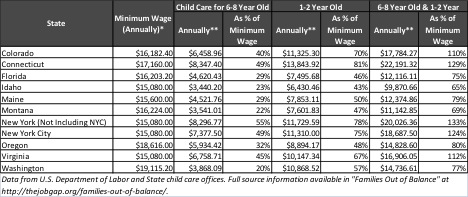
The cost of child care for a school age child and a toddler is equal to more than 65 percent of a full-time minimum wage worker’s earnings in the 10 states included in the Alliance’s November 2014 report, “Equity in the Balance,” and is over 100 percent of their earnings in Colorado, Virginia, Connecticut, and New York.

When working parents don’t have a family member or friend who can look after their children for free or low cost, they have to pay for reliable child care. Although child care workers are among the lowest paid workers, earning a median wage of only $9.38 per hour in 2012, the cost of child care for parents is significant.

In the 10 states included in the Alliance’s 2014-2015 Job Gap Economic Prosperity Series, child care costs make up a large portion of the cost of living. In states we studied, paying for before-and-after- school and summer care for a 6-8 year old ranges from $3,440 per year in Idaho to $8,347 per year in Connecticut.

For a toddler, the cost of full-time child care ranges from $6,430 per year in Idaho to $13,844 in Connecticut. When parents have two children, nearly every state studied has a cost of over $10,000 per year, with New York (not including New York City) and Connecticut costing over $20,000 per year. (See chart at end of article).

While it’s true that many minimum wage workers are eligible for subsidized child care, a 2012 brief by the U.S. Department of Health & Human Services estimated that only 18 percent of children from eligible families actually received subsidies.

Further, only one state in the country currently has child care subsidy rates set at the recommended 75 percentile of market rates in 2014. Only three more have their rates set to the 75 percentile of 2013 market rates.

Because the most states allow providers to charge parents the difference between the subsidy rate and their standard rate, many parents who receive subsidies still must pay more than the subsidy co-pay, cutting deep into the already meager budgets of minimum wage workers.

In addition to the struggle minimum wage workers have affording child care, many states have restrictions on receiving subsidies when a worker loses their job or when they are unemployed and looking for work.

As the National Women’s Law Center shows, five states cut off subsidies after a parent loses their job, and another seven provide less than one month of subsidy after job loss. Further, 35 states and the District of Columbia do not provide any subsidies when a parent is unemployed, but actively searching for work.

When parents lose a job or only earn minimum wage, the cost of child care can be an insurmountable obstacle to making ends meet. A higher minimum wage can help workers across the country better afford the cost of child care. At the same time, addressing the high cost of care – while also ensuring that child care workers earn enough to support themselves and their families – would help families across the country.

Over the next few months, the Alliance for a Just Society will be taking a look at some of the components that go into calculating a living wage, and show why it’s impossible to make ends meet working full-time at minimum wage.
Child care chart

Testimony: A Living Wage Is about Family Prosperity

Yesterday I got the chance to testify to the Washington state House Labor and Workforce Development Committee.

Our living wage research findings set a standard, that mere survival is not an adequate measure of a healthy society, and not an expectation we should be striving to set. It’s about a living wage that positions families to build for the future and realize their dreams.Continue reading “Testimony: A Living Wage Is about Family Prosperity”

I Give Thanks to Workers Standing Up to Injustice

The holiday season — a time of counting your blessings, spending time with your family, and abundance.

It is also a time for a huge portion of workers — unable to make basic ends meet — to be made painfully aware of how they are falling short.

About half of all full-time workers of color in the United States do not make $15 a or more an hour, a figure that actually is not a living wage for a single adult in most places.Continue reading “I Give Thanks to Workers Standing Up to Injustice”

Ferguson Tragedy is a Mandate to Change Police Policies and Practices in Our Country

For Immediate Release

November 24, 2014
ALLIANCE FOR A JUST SOCIETY
Contact: Kathy Mulady,
Communications Director
(206) 992-8787
or Libero Della Piana,
Senior Organizer
Ferguson Grand Jury Decision in the Killing of Michael Brown

The Alliance for a Just Society joins with millions of people who are outraged and incredulous that no indictment was made of officer Darren Wilson for killing the unarmed teenager in Ferguson, Missouri on August 9, 2014.

An indictment is not a verdict, it is simply the acknowledgement that a life was wrongly taken and that a trial is necessary to review the evidence and to determine whether the officer is guilty of murder, manslaughter, or is innocent.

No indictment means no pursuit of the truth, and little chance of justice.

“The tragedy that happened in Ferguson is a mandate to change the policy and practice of policing around the country,” said LeeAnn Hall, executive director of the Alliance for a Just Society.  “Let’s end a system that allows police to take the lives of young black men, any person of color, or anyone’s child without facing the consequences.”

There have been far too many distortions, reversals and changed stories from the Ferguson Police Department about the incident. The public still doesn’t know everything that happened that day, nor do we know Darren Wilson’s version of events.

We are also disturbed by the preparation for violent conflict and confrontation by the local police in Ferguson and the State of Missouri.

Missouri Gov. Jay Nixon declared a State of Emergency last week in advance of the Grand Jury decision and ahead of predicted “violent protest.” The fact is that protests in Ferguson, the surrounding area, and around the country have been largely peaceful. The governor’s decision and stockpiling of riot gear sets a dangerous tone for police.

Tension rose in Ferguson in the wake of Michael Brown’s killing in large part due to police violence and excessive response towards protesters. Journalists, local clergy, bystanders and protesters were locked up, tear-gassed, beaten, harassed and arrested over the past three months.

In this moment of miscarried justice we must all take action.

  • We call on the police and other authorities to respond responsibly and peacefully to the legal and rightful protest of the Grand Jury decision. We have a right to march, protest and to call attention to the prevalence of police violence and brutality in communities of color in this country.
  • We call for demilitarizing the police and a stop to federal programs that provide subsidized or free military equipment to local authorities.
We cannot let Michael Brown’s death be in vain.
# # #


Ferguson Mandate: Time to Change Police Policies and Practices

The Ferguson grand jury has announced its decision in the killing of Michael Brown.

The Alliance for a Just Society joins with millions of people who are outraged and incredulous that no indictment was made of officer Darren Wilson for killing the unarmed teenager in Ferguson, Missouri on August 9, 2014.

An indictment is not a verdict, it is simply the acknowledgement that a life was wrongly taken and that a trial is necessary to review the evidence and to determine whether the officer is guilty of murder, manslaughter, or is innocent.

No indictment means no pursuit of the truth, and little chance of justice.

“The tragedy that happened in Ferguson is a mandate to change the policy and practice of policing around the country,” said LeeAnn Hall, executive director of the Alliance for a Just Society.  “Let’s end a system that allows police to take the lives of young black men, any  person of color, or anyone’s child, without facing the consequences.”

There have been far too many distortions, reversals and changed stories from the Ferguson Police Department about the incident. The public still doesn’t know everything that happened that day, nor do we know Darren Wilson’s version of events.

We are also disturbed by the preparation for violent conflict and confrontation by the local police in Ferguson and the State of Missouri.

Missouri Gov. Jay Nixon declared a State of Emergency last week in advance of the Grand Jury decision and ahead of predicted “violent protest.” The fact is that protests in Ferguson, the surrounding area, and around the country have been largely peaceful. The governor’s decision and stockpiling of riot gear and materials sets a dangerous tone for police.

Tension rose in Ferguson in the wake of Michael Brown’s killing in large part due to police violence and excessive response towards protesters. Journalists, local clergy, bystanders and protesters were locked up, tear-gassed, beaten, harassed and arrested over the past three months.

In this moment of miscarried justice we must all take action.

  • We call on the police and other authorities to respond responsibly and peacefully to the legal and rightful protest of the Grand Jury decision. We have a right to march, protest and to call attention to the prevalence of police violence and brutality in communities of color in this country.
  • We call for demilitarizing the police and a stop to federal programs that provide subsidized or free military equipment to local authorities.

We cannot let Michael Brown’s death be in vain.

LeeAnn Hall’s Statement on Executive Action for Immigration

For Immediate Release

November 20, 2014
Contact: Kathy Mulady,
Communications director
(206) 992-8787

Statement from LeeAnn Hall, executive director of the Alliance for a Just Society, regarding President Obama’s announcement on executive action for immigration:

“This is a great step forward for everyone in our country,” said LeeAnn Hall, executive director of the Alliance for a Just Society. “Now Congress needs to step up to enact real bipartisan immigration reform that includes a path to citizenship for the 11 million undocumented people in the country, and that respects the dignity of all immigrants in the United States.”

The Alliance for a Just Society released numbers this week showing that non-citizens have significantly less access to jobs that pay enough to make basic ends meet, leaving them more likely to live in poverty and unable to fully participate in their local economy.While nearly two-thirds of citizens working full-time earn $15 or more, only one-third of non-citizens earn this much. That is 63 percent of citizens compared to 38 percent of non-citizens.

“The president’s action takes us a step closer to reducing the economic racism which is at the heart of the immigration issue,” said Hall.


Only 52 percent of Full-Time Workers of Color Earn Enough to Make Ends Meet

FOR IMMEDIATE RELEASE
Nov. 18, 2014
Contact: Kathy Mulady, communications director
kathy@allianceforajustsociety.org

Only 52 percent of Full-Time Workers of Color Earn Enough to Make Ends Meet

Just 57 percent of women and 42 percent of Latino workers earn enough working full time to cover their basic needs

SEATTLE — During this season of abundance, many full-time workers across America don’t earn enough for a single person to survive, much less to support a family. The staggeringly low percentage of women and people of color who earn a living wage is especially troubling.

“Equity in the Balance,” a report by the Alliance for a Just Society released today, details just how few women, people of color, and non-citizens in the U.S., working full-time, make a living wage — that is, earn enough income to cover basic expenses.

Only 61 percent of all full-time workers earn a wage that allows a single adult to make ends meet. Only 57 percent of women, and just 52 percent of people of color make a living wage. Just 42 percent of Latino workers earn enough to make ends meet. Among non-citizen workers, only 38 percent earn more than $15 per hour.

“A system that unjustly and persistently leaves people of color over-represented in low-wage work is economic racism,” said LeeAnn Hall, executive director of the Alliance for a Just Society. “Policies that keep women over-represented among low-wage workers is gender discrimination.

“It’s time to increase the national minimum from a $7.25 poverty wage to $15 an hour to ensure that full-time work pays enough to do more than barely survive, and so our families and economy can thrive.”

“Equity in the Balance” is a groundbreaking report, said Dorian Warren, associate professor of political science at Columbia University.

“No one in the country is talking about economic racism – and here, in this report, are the numbers that clearly illustrate its existence and its impact,” Warren said. “When people talk about poverty, race has disappeared from the conversation. The economy and race have become uncoupled in our country.”

Policies and practices in the U.S. have perpetuated low wages in jobs and industries where women and people of color primarily work. 

“ ‘Equity in the Balance’ provides a stark national picture of what we’ve been seeing over the past decade in the restaurant industry, one of the largest private-sector employers in the nation. Women and people of color bear the brunt of the country’s growing income inequality gap,” said Saru Jayaraman, director of Restaurant Opportunities Centers United.

“Increasingly, the only jobs available to all people are low-wage jobs,” Jayaraman said. “The difference for women and people of color is that they are never able to move out of these jobs and into positions that will allow them to support their families.”

Women of color struggle even more, and are forced to make difficult choices to provide for their children.

“For the first time in history in the U.S., women make up half of the paid labor force.  Many of them are moms who are either the sole breadwinner or the primary breadwinner for their families,” said Kristin Rowe-Finkbeiner, executive director of MomsRising.

“Women’s incomes are essential to family economic security – and that economic security is critical to our nation’s overall economic health. That’s our modern reality,” said Rowe-Finkbeiner.

“Equity in the Balance” is the second report in the 2014 Job Gap Economic Prosperity Series. Alliance for a Just Society has produced Job Gap studies on jobs and wages since 1999.

Data from the Alliance’s Job Gap Study figure prominently in debates on minimum wage, paid sick days, payday lending, Medicaid and other family economic issues.

Here is a summary of the recommendations in the report:


  • Increase the federal minimum wage. Wages should provide enough for workers to more than make ends meet. A $15 national minimum wage would approach  a living wage covers basic expenses and sets aside some savings for emergencies.
  • Eliminate the federal tipped minimum wage that has been stagnant at $2.13 per hour for over 20 years. That is not a formula for economic prosperity.
  • Invest in state and federal safety net programs, such as childcare assistance. Until there are enough living wage jobs to go around for all household types, families will continue to face tough choices.
  • Guarantee paid leave that includes maternity leave and parental leave to care for sick children. Many workers risk losing their jobs or income, if they are too sick to come to work or if they need to care for a sick child.
  • Unionize occupations and industries that pay the lowest wages, including fast food, home care and farm work to help women and people of color earn increased wages and benefits.
  • Prohibit pay secrecy and encourage transparency. When employers either formally or informally discourage or even forbid employees from sharing wage information, it leaves employees unaware that they are being underpaid.
  • Expand and Strengthen Social Security: Because women and people of color earn less, they are less able to save for retirement and forced to depend solely on Social Security.
 Alliance for a Just Society is a national policy, research and organizing network with 14 state affiliates, that focuses on health, racial and economic justice.
# # #