Ban the Box: Two Big Wins for the Fair Hiring Campaign in Florida

Last week, small business owners, activists, and faith leaders gathered on the steps of the Daytona Beach City Hall to announce the City of Daytona’s plan to “ban the box” and open up opportunities to all applicants by removing the criminal conviction question from city job applications.

The effort, commonly known as “ban the box” because of the box that job applicants are routinely asked to check if they have ever been convicted of a crime, was more than six months in the works.

In January members of the Main Street Alliance of Florida began meeting with city leaders, providing testimony at City Commission meetings, and placing several editorials in local and national newspapers to promote adoption of the fair chance policy.

Several City Commissioners and City officials attended the press event June 1, and voiced their commitment to a fair chance for all job applicants. They echoed the concerns of Main Street Alliance leaders, discussing the economic impact of locking previously convicted applicants out of the job market.

Jim Sexton, human resources manager for the City of Daytona Beach, told reporters that background checks would still be conducted, but they would only be done when a position had been offered.

“When the application goes to the hiring department they won’t know the applicant’s record. They will view that person the way a new-born baby views the world, without bias,” said Sexton.

Daytona Beach was the second city to ban the box in what turned out to be a huge month for supporters of fair hiring. Two weeks prior to Daytona’s announcement small business owners and faith leaders sent a letter to Orlando Mayor Buddy Dyer letting him know about their plan to bring the “ban the box” campaign to Orlando following the decision in Daytona Beach.

Before leaders could shift their full attention to Orlando, the mayor there announced his executive order to remove the criminal conviction from applications for city jobs.

Orlando’s decision now means that four of the five most populated cities in Florida have passed policies that reduce barriers to employment for people with prior convictions.

Miami is the only remaining major city that does not have a policy in place, providing an ideal next step for the Main Street Alliance of Florida leaders and their allies.
Los Angeles is Biggest City to Enact $15 Minimum Wage

Los Angeles has become the biggest city in the nation to gradually raise the minimum wage to $15 an hour, Los Angeles City Council members voted 13-1 today to more than double the federal wage by 2020.

Los Angeles City Council members signaled two weeks ago that they would raise the minimum wage, and took the final vote today at their regular meeting.

During the earlier meeting, Kevin Litwin of Main Street Alliance of California, spoke in support of raising the wage even higher.Watch his testimony here: https://youtu.be/C2kEs8D3ZIY

“I am the Chief Operating Office at Joe’s Parking, and a member of the Main Street Alliance. Together we are support raising the L.A. minimum wage to $15.25. When Joe’s Auto Parks was founded in 1959 minimum wage was just $1 an hour. We didn’t pay the minimum then, and we don’t pay the minimum now. For over 50 years we have been committed to offering fair wages and attracting the best and brightest employees to manage our locations. That’s how we grew to one of the largest operations here in downtown L.A. We strongly hope you pass this and raise the wage to $15.25,” said Litwin.

The Council chambers were packed with more than 100 residents of the city, the vast majority supporting the minimum wage increase, and dozens of workers and community leaders providing comment echoing Litwin’s support.

After hearing the support and concerns of those in attendance the Council turned in a 14-1 vote in favor of raising the city’s wage to $15 gradually over the next 5 years. The full council vote next week before being written into law. The first wage bump will occur in July of 2016 when wages will rise to $10.60 an hour annually on their way to $15 by 2020.

Los Angeles joins Seattle and San Francisco, cities that recently passed laws to phase in a $15 minimum wage over several years. Chicago passed a minimum wage increase that plateaus at $13.

Cities and states throughout the country are discussing and debating minimum wage increases, including Maine, where Maine People’s Alliance is circulating petitions for a minimum wage referendum.


Job Gap Research is Key as New York Groups Fight for Fair Wages

Fast food workers in New York took another big step toward winning fair wages two weeks ago when Gov. Andrew Cuomo announced the convening of a new Wage Board to examine and make recommendations about increasing the minimum wage in the state’s fast food industry.

Cuomo’s office has now announced the next steps in the Wage Board process, including plans for four public hearings in June – in Buffalo, New York City, Long Island and Albany – to take public testimony.

Alliance for a Just Society salutes the broad coalition of community and labor groups in New York. Their disciplined organizing, savvy strategizing, and major mobilizations demonstrating strength in numbers, have raised the public demand and built the grassroots momentum to make this progress possible.

Alliance affiliates Citizen Action of New York, Make the Road New York, and Restaurant Opportunities Center United of New York have all played important roles in the ongoing organizing for fair wages in the state.

They helped secure a $2.50 increase in the minimum wage for tipped workers through the Wage Board process in February, raising the tipped minimum wage to $7.50 an hour – and marking a major step forward for the One Fair Wage campaign to end subminimum wages. This victory was a big win. It has since proved doubly significant: by demonstrating the potential of the Wage Board process, it paved the way for the governor to employ that process again now.

These organizations mobilized hundreds of grassroots members to join Fight for $15 events in New York City and in cities across the state on April 15, elevating fast food workers’ demands for $15 an hour and union rights and building momentum in the ongoing push to raise wages.

They coordinated legislative strategies in Albany to pass a strong minimum wage bill (phasing up to $15 an hour in New York City and its suburbs, and $12.60 an hour statewide) through the State Assembly on May 4. These moves raise the stakes for the governor to take executive action on wages in light of the legislative gridlock in the State Senate.

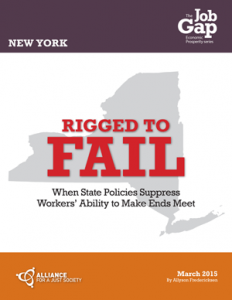
As the new Wage Board convenes and as the coalition partners in New York organize to ensure that grassroots voices calling for a $15 wage are heard at every public hearing across the state, the Alliance’s research on what constitutes a living wage in New York provides an important benchmark for the Board’s investigation.

According to the installment of our Job Gap Economic Prosperity Series, the living wage for a single worker in New York State is $18.47 an hour. In New York City, with its higher costs of living, the living wage for a single worker is $22.49 an hour. For families with children, the living wage levels are significantly higher once child care costs are factored in).

Under New York State law, a Wage Board can recommend changes to the minimum wage in a specific industry if it finds that wages are insufficient to provide for the life and health of workers. Based on the Job Gap living wage research, that’s clearly the case with fast food wages in New York today. Looking at what it actually costs to make ends meet in New York, this much is clear: the time for a $15 wage floor is now.

The new Wage Board can make $15 an hour a reality for New York’s fast food workers. The coalition of partners in New York is gearing up to mobilize for the raise fast food workers need, pushing toward another big victory on fair wages.

But we know the fast food Wage Board won’t be the end of the fight for fair wages in New York. Instead, for organizers and grassroots leaders in communities across the state it’s the next landmark on the road to winning an increase in the minimum wage for all workers in New York.

LeeAnn Hall is the executive director of Alliance for a Just Society, a national organizing network with affiliates in 20 states.