Celebrate 50 Years of Medicaid by Expanding It to Cover More People

Persistence pays off. Let’s remember this as we celebrate 50 years of Medicaid on July 30.

In 1965, Medicaid entered the world as a Medicare add-on for low-income families. Now, the program provides comprehensive coverage to more people than any other insurer in the United States. Almost 70 million people in the U.S. turn to Medicaid for their health coverage.

But Medicaid is much more than the country’s top health insurer. It’s also a key battleground for the future of our country.Continue reading “Celebrate 50 Years of Medicaid by Expanding It to Cover More People”

Winning on Student Loan Reform … From CT to MT

Across the country, student loan borrowers and their allies have been organizing to make college more affordable and push for state-level reforms that address the mountain of student debt that’s weighing down students and families. And they’re winning… all the way from Connecticut to Montana.

In Connecticut, where the 2015 legislative session ended at midnight on June 3rd, Alliance affiliate Connecticut Citizen Action Group (CCAG) co-convened and provided staff support for the Higher Ed, Not Debt – CT coalition, a coalition of community and labor allies that formed last fall and championed affordable higher ed and student loan reforms in the legislature this year.Continue reading “Winning on Student Loan Reform … From CT to MT”

Walmart’s Offshore Tax Havens Hurt Small Businesses That Support Communities

A recent report released by Americans for Tax Fairness exposed Walmart for their evasive tax practices and revealed that the retail giant is holding over 78 billion dollars in offshore subsidiaries. Our members were quick to speak out against these practices and took to the media to make their voices heard.

Matt Birong, owner of 3 Squares Café (a cute and comfortable spot in Vergennes, VT) and member of the Main Street Alliance of Vermont, compared the high road business practices of his company to the extractive economic policies of Walmart and other multinational corporations in his article, featured in The Hill.

“Small businesses like mine are being squeezed by tax policies written for the upper echelon. Even though our revenue sheets look much different than those of the retail giant, we are forced to supplement the income of their employees and absorb a larger share of the tax responsibility,” said Birong.

Kelly Conklin, a member of the Main Street Alliance national executive committee, owner of Foley-Waite cabinets in New Jersey, also weighed in on the issue and spoke about growing his business while supporting his community in his article, featured in the Augusta Free Press.

“Small businesses can’t afford an army of accountants and tax lawyers like Walmart can to create offshore tax-avoidance strategies,” said Conklin. “None of us have shell corporations in Luxembourg. Even if we could pull off such financial shenanigans, I honestly believe most of us wouldn’t want to.”

“We’d rather contribute what we should to the public good and see our communities thrive right alongside our businesses,” said Conklin.

Small business owners already face stiff competition from large corporations, like Walmart, that can execute bulk purchases and drive down prices. The latest tax evasion revelation demonstrates just how far the scales are tipped in favor of big businesses.

Congress can act to rein-in these practices – and our leaders will continue to work to make sure their voices are heard on this issue.

NY Fast food workers win $15 minimum wage

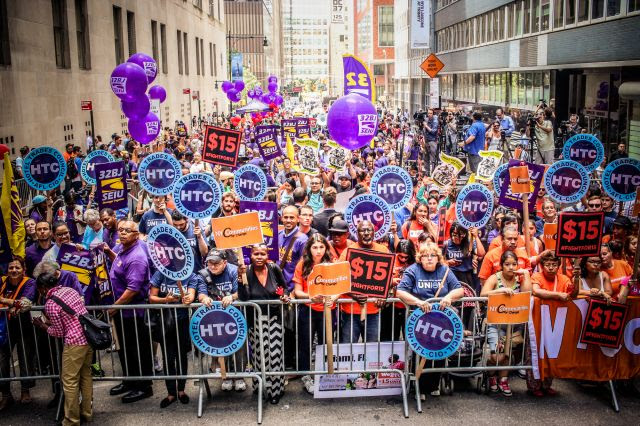
Fast food workers in New York are getting a raise!

Hard work by our affiliates Citizen Action New York and Make the Road New York – along with dozens of other allied organizations and unions, and thousands of workers who took to the streets and shared their personal stories – has paid off  in a huge victory.

Yesterday, the New York State Wage Board approved gradually raising the minimum wage for New York City fast food chain employees to $15 an hour by 2018. Fast food workers throughout New York state will gradually raise to $15 an hour by 2021.

“This is a huge victory for fast food workers, and for everyone working for low wages in New York,” said LeeAnn Hall, executive director of the Alliance for a Just Society.  “It puts pressure on employers in other low-paying industries to start paying their workers a living wage.

“I applaud the hard work of everyone who fought for this important moment,” said Hall.

Fast food workers are paid less than any other occupation, and fast food work is projected to be the second largest growing occupation (PDF) in the country, with more openings than nearly any other.

This momentous victory brings fast food workers in New York significantly closer to earning a wage that will allow them to support themselves. It will boost their own financial stability, their communities, and the economy for all of us.

In New York and many other states, $15 is still a modest wage. This increase however allows workers to come closer to making ends meet.

In the report “Families Out of Balance” by the Alliance for a Just Society, our research shows that a living wage for a single adult is $18.47 an hour in New York state and is $22.49 an hour in New York City.

A pay raise is long overdue for all our workers nationwide. Tomorrow marks six years since the federal government last raised the minimum wage – to $7.25 on July 24, 2009.

A bill was introduced in the U.S. Senate Wednesday by Sen. Bernie Sanders (I-Vt.), and in the House by Rep. Keith Ellison (D-Minn.) and Rep. Raul Grijalva (D-Ariz.), to raise the federal minimum wage to $15 an hour.

If the wage can be raised in Seattle and New York and Los Angeles and so many other cities, it can be raised nationally – and we can do it.

Congratulations New York! The struggle continues!unnamed (4)

Fast Food Workers in New York are Getting a Raise!

Hard work by our affiliate Citizen Action of New York – along with dozens of other allied organizations and unions, and thousands of workers who took to the streets and shared their personal stories – has paid off  in a huge victory.

Yesterday, the New York State Wage Board approved gradually raising the minimum wage for New York City fast food chain employees to $15 an hour by 2018. Fast food worker wages throughout New York state will gradually raise to $15 an hour by 2021.

“This is a huge victory for fast food workers, and for everyone working for low wages in New York,” said LeeAnn Hall, executive director of the Alliance for a Just Society.  “It puts pressure on employers in other low-paying industries to start paying their workers a living wage.

“I applaud the hard work of everyone who fought for this important moment,” said Hall.

Fast food workers are paid less than any other occupation, and fast food work is projected to be the second largest growing occupation in the country, with more openings than nearly any other.

This momentous victory brings fast food workers in New York significantly closer to earning a wage that will allow them to support themselves. It will boost their own financial stability, their communities, and the economy for all of us.

In New York and many other states, $15 is still a modest wage. This increase however allows workers to come closer to making ends meet.

In the report “Families Out of Balance” by the Alliance for a Just Society, our research shows that a living wage for a single adult is $18.47 an hour in New York state and is $22.49 an hour in New York City.

A pay raise is long overdue for all our workers nationwide. Tomorrow marks six years since the federal government last raised the minimum wage – to $7.25 on July 24, 2009.

A bill was introduced in the U.S. Senate Wednesday by Sen. Bernie Sanders (I-Vt.), and in the House by Rep. Keith Ellison (D-Minn.) and Rep. Raul Grijalva (D-Ariz.), to raise the federal minimum wage to $15 an hour.

If the wage can be raised in Seattle and New York and Los Angeles and so many other cities, it can be raised nationally – and we can do it.

Congratulations New York!


In Weighing Racial Discrimination, Consider Outcome, Not Just Intent

In the last two weeks, the Supreme Court handed down some monumental decisions: health care subsidies were upheld, ensuring millions will continue to see the benefits of the Affordable Care Act; and marriage equality became the law of the land, allowing LGBTQI people to marry. But, there was another major decision tucked in there, too: in Texas Department of Housing and Community Affairs et al v. Inclusive Communities Project, Inc., et al, the Supreme Court affirmed that it is not the intent of racial discrimination that matters, but the impact.

In some instances, rules may be in place that appear to be colorblind or even prevent racial discrimination, but racial bias and racist actions still lead to disparate impact. This was the case in Seattle, where the city’s Office for Civil Rights uncovered evidence of discrimination at 13 rental properties across the city. There, prospective tenants were treated differently depending on their race, gender identity, sexual orientation, and/or national origin. Such discrimination is not limited to housing, of course; people of color, especially, are discriminated against in nearly all areas of life, including policing, employment, and childhood education.

When we envision discrimination, we typically think of situations like these where it comes from individuals and leads to a broader impact on people of color.

However, the recent Supreme Court decision centered on a case where funds designed in part to combat segregation were distributed so that they instead contributed to continuing segregation. Here, it was not racist individuals or racial bias that led to such disparate impact; it was, instead, a lack of recognizing that impact and thinking strategically about alternatives that could better counter the existing segregation.

This short-sightedness and lack of a racial justice lens led to a concentration of low-income housing in communities of color, contributing to, rather than changing a system that ghettoizes low-income communities of color.

On July 8, President Obama announced stricter rules against housing segregation, including requiring local governments to account for “how they will use federal housing funds to reduce racial disparities.” This is an important step in helping local governments avoid the short-sighted actions that occurred in Texas, and could make significant progress in addressing the concentration of poverty in communities of color.

However, we must recognize that systemic and economic racism are entwined within more aspects of our society than housing. Expecting a housing fix to assure we avoid the 1968 prophecy noted by Justice Kennedy that the nation “is moving toward two societies, one black, one white – separate and un-equal” would itself be short-sighted. Instead, we must seek to recognize, call out, and address all policies and actors that, intentionally or not, perpetuate a system of economic racism. Whether in health outcomes, voting rights, policing, higher education, employment, or nearly any other area, policies and actions must take into account their impact on people of color in order to dismantle to a system of economic racism that has existed in this country for far too long.

“Feeding Ourselves” Connects Native American Health Disparities and Federal Policies

In 1940, diabetes among Native Americans was almost unknown. The disease began appearing in the 1950s and expanded until during the 1960s it became a common condition. Today, nearly every Native American is involved either personally with diabetes, or has family and friends with diabetes,

According to a new report released today, Diabetes has been called the new smallpox.

“Researchers point to dramatic changes in the traditional diet of Native Americans, the rise in sedentary lifestyles, poverty, loss of culture, trauma and other factors as contributing to this epidemic,” according to the report.

The Native Organizers Alliance (NOA), a project of the Alliance for a Just Society, contributed work and research to Feeding Ourselves: Food access, health disparities, and the pathways to healthy Native American communities.” The extensive report, released today, examines food access in Native American communities and health disparities.

The report analyzes the impacts of federal policies that forcibly separated Native people from their historical lands and traditional sources of food. Those policies are manifesting in Native American health disparities today.

“Separation from healthy foods has been one of the most pernicious health problems we endure,” according to the report.

More than 80 percent of Native American adults are overweight or obese, according to the Indian Health Clinic Reporting System. Four-year-old Native American children have twice the obesity of their white counterparts, according to a Robert Wood Johnson Foundation study.

The report found that most of tribal lands are in food deserts, areas that lack access to healthy food. It detailed the historical and economic factors that have broken down the Native American food system.”

In the report, Judith Le Blanc, national coordinator for the Native Organizers Alliance, of the Alliance for a Just Society, shares:

“With technical support, tribal governments, service entities and local organizers can build significant community support for basic policy changes. Public education framed by Native traditions can be created to foster an understanding of the long history of healthier environments captured in our histories. To achieve an all-around healthier environment that includes community communication, commitment and continuing access to decision makers, we need a resourced organizing infrastructure of local activists that has a role far beyond funding cycles and tribal and local elections.”

“Feeding Ourselves” was commissioned by the American Heart Association (AHA) and Voices for Healthy Kids, a joint initiative of the Robert Wood Johnson Foundation and AHA.

The report is report’s authors include Crystal Echo Hawk of Echo Hawk Consulting; Janie Hipp, Director of the Indigenous Food and Agriculture Initiative, Visiting Assistant Professor of Law; Wilson Pipestem, founder, Pipestem Law and Ietan Consulting

Alliance for a Just Society worked on the report through the Praxis Project’s Communities Creating Healthy Environments (CCHE) Program Indian Country technical assistance partner.

Oregon bans racial profiling

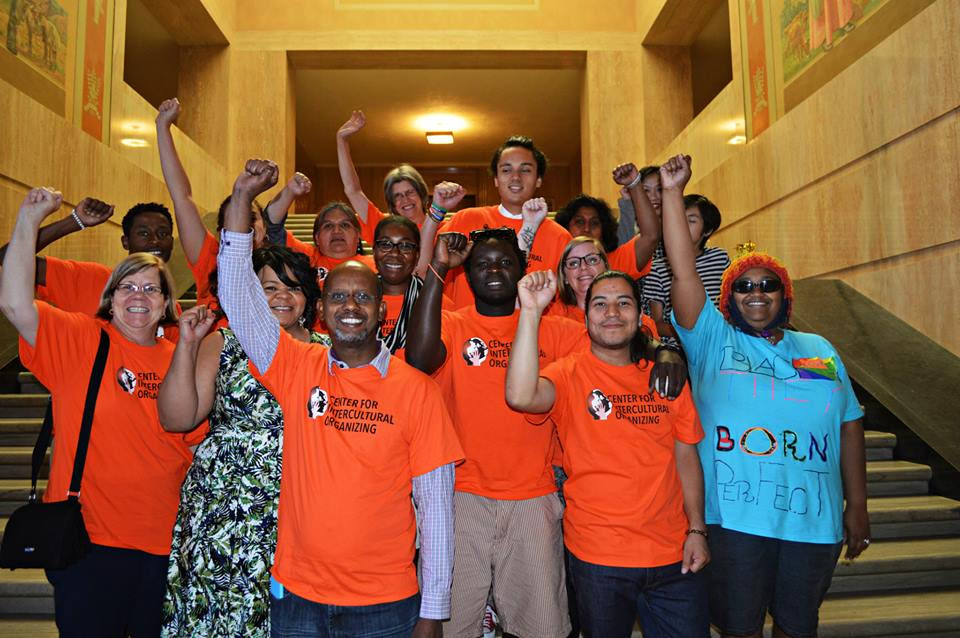
The Alliance and our affiliates Center for Intercultural Organizing and Oregon Action have been organizing to put an end to racial profiling in Oregon for a decade. The first week of July, 2015, those years of organizing paid off when the Oregon Senate passed HB 2002 – a comprehensive anti-profiling bill – and sent it to the governor’s desk for her signature.

The work that built toward this victory traces back to 2006, when OA, CIO and the Alliance partnered with the Northwest Constitutional Rights Center and the Portland Police Bureau to organize a groundbreaking series of community listening sessions across Portland that brought together community members and Portland police officers for real dialogues on the issue of racial profiling.

After those sessions, the Alliance co-authored a report, Listening Sessions Report: A Community and Police Partnership to Eliminate Racial Profiling (PDF), that documented the problem and offered concrete recommendations for eliminating profiling in Portland.

But that was only the beginning of this work. In the years since, CIO and OA have continued to organize around profiling issues – collecting stories from community members who have faced profiling, making the connections between police profiling and discriminatory “ICE holds” (when immigrants are held in local jails after their charges are cleared at the behest of Immigration and Customs Enforcement), building coalition relationships, engaging in dialogues with law enforcement associations, and mobilizing grassroots supporters to build momentum for change.

The passage of HB 2002 last week represents a landmark victory in this long fight to end profiling.

HB 2002 provides a clear definition of profiling and requires all law enforcement agencies in the state to ban it. The definition encompasses profiling based on race, ethnicity, skin color, national origin, language, gender, gender identity, sexual orientation, religion, political affiliation, homelessness, and disability – a comprehensive definition that can serve as a model for other states.

HB 2002 also establishes a process for accepting and addressing complaints about profiling and includes provisions for the collection and analysis of complaint data – critical handles for enforcing the profiling ban.

While we celebrate this win with our Oregon affiliates and partners, we’re already looking ahead to what’s next: more boots-on-the-ground work to make sure the new law is fully and fairly implemented.

Here’s what Kayse Jama, Executive Director of CIO, had to say: “By defining profiling and establishing a consistent process for recording complaints, we can help build trust between law enforcement and the communities they serve. This legislation is an important step toward ending a systemic problem, but it does not mean our work is done. Actual change has to be felt on the ground.”

Read the full press release.

CIO celebrates anti-profiling victory
Staff and members of Oregon’s Center for Intercultural Organizing celebrate the passage of anti-profiling legislation in the state.

Take Down the Confederate Flag – And Raise Up Medicaid Expansion

This opinion piece by LeeAnn Hall was originally published in Huffington Post.

It’s tempting, this summery week, to sit and savor the sweet victory that was handed us by the Supreme Court in late June with the King v. Burwell decision. The court’s ruling protected the health care subsidies that allow 6.4 million people to afford their health insurance.

Many of those are people who have health insurance and routine health care for the first time in their lives because of the Affordable Care Act. Now they can breathe a little easier, knowing they can go to the doctor when they are sick, get immunizations, medications and preventive care.

The Supreme Court’s ruling came a week after the horrifying news that nine people were killed while praying inside the Emanuel AME church in Charleston, South Carolina.

One of those killed was Rev. Clementa Pinckney, a South Carolina senator who was a tireless advocate for Medicaid expansion in his state. Some called him the “moral conscience of the South Carolina legislature.”

The killings in Charleston spurred the long overdue call to remove the Confederate flag from public buildings and from license plates. Removing the symbols of racism and inequity is a significant step. Just as critical is the need to remove racist barriers to quality health care.

We must continue to fight for the nearly four million people who still don’t have access to health care because of their state lawmakers’ refusal to expand Medicaid. Nearly 90 percent of those in the health care coverage gap live in the South, and they are disproportionately people of color.

It’s time to stop debating the right to health care – that discussion is done. Now it’s time to make quality health care a reality for everyone. The Affordable Care Act is here to stay.

Billions of dollars in federal funding is in place for legislators to extend health care to everyone in their states. Yet, lawmakers in 19 states have refused to accept that funding – 13 of those states are in the South.

It’s time to end policies that perpetuate systemic racism. I ask these legislators and governors – what are you so afraid of that you would deny a mother a visit to the doctor, or a father medication he needs to be strong for his children?

Refusal to expand Medicaid and provide quality health care to all remains a stark and shameful example of our nation’s failure to overcome persistent racial disparities.

President Obama, in his elegant eulogy in Charleston, said: “It would be a betrayal of everything Reverend Pinckney stood for, I believe, if we allowed ourselves to slip into a comfortable silence again.”

We must all remain uncomfortable – and outspoken – until racism, fear and hate are erased, in our symbols and in our policies. One step must lead to the next step.

Taking down the Confederate flags would be a bold symbolic statement that reconciliation has at long last begun. Expanding Medicaid to millions of people would show that we really mean it.

LeeAnn Hall is the executive director of the Alliance for a Just Society, a national policy and organizing network that has produced pivotal reports for 20 years on national health issues.

Native Organizers: Building a Grassroots Movement in Indian Country

Thirty organizers and activists from across Indian Country came together in Seattle in June for a special training opportunity hosted by the Native Organizers Alliance: the annual intensive four-day Native Organizing Training.

Grassroots organizing is both an art and a science. In Indian Country, the art of organizing is reflected in the Native-led action against oil drilling in the Arctic by the ‘Kayaktivists’ in the “Paddle in Seattle”, and the round dance flash mobs of Idle No More.

In four days our aim was to study the science of organizing – Native style, in keeping with our traditions and with our history.

In our jam-packed, daylong sessions, we explored ways to build Native organizers’ skills to meet the unique challenges of organizing in Native communities, on reservations, and in urban and rural centers. We shared lessons, best practices and examined the techniques for building a stronger grassroots movement for social change in Indian Country.

In the end some participants said we needed another day, and most agreed we needed more breaks and time to digest the information. Good advice for next year’s Native Organizing Training!

While exploring the nuts and bolts of outreach, leadership development, strategy and tactics, the participants worked to find the unique, yet critical elements of community engagement that flow from Indian Country’s history and traditions.

After four intensive days together, it is clear that here is so much more to learn about how to deepen our understanding of Native community organizing.

This is just the beginning! The future of Indian Country rests on growing a broad infrastructure of Native organizers and activists who facilitate campaigns that get at the root causes of the lack of jobs, healthy communities and protect treaty rights, sovereignty and Mother Earth from destruction.

The training provided an opportunity to share stories of the tremendous challenges our communities face and our vision and passion for bringing about structural change that will help Native communities not only survive, but also thrive.

The participants were hungry for more opportunity to go deeper into the challenges they face on the ground. Next year’s sessions will need to provide that opportunity in various ways.

Some participants asked that we now consider regional trainings that go beyond Native Organizing 101, to tackle more real life, complicated strategic challenges in Indian Country.

Some suggested segments focused on political empowerment related to advocacy, voter engagement and lobbying. In their written evaluations most said that the most important part of the experience was getting together with others who share a common outlook on movement building in Indian Country.

Especially impressive were the younger participants,coming from cutting edge Indian Country experiences. For instance, one of the activists is a part of the occupation to protect sacred Apache land from uranium mining in Oak Flat, AZ. Another was a Native radio talk show host, and one young man will be headed to the White House for the Native youth gathering in the next week.

One woman representing the “AIM generation” (radicalized in the 1970s) is a traditional Dine organizer. She has been fighting for decades for compensation from the coal and uranium mining companies for the contamination of Navajo land, water and air. She felt uplifted by the energy of the young organizers in the room, who are just beginning the fight for justice in their communities.

One of the most popular sessions of the training was on power mapping. David Bender, the community organizer for the American Indian Center of Chicago, said learning how to map the potential allies and likely opponents in an organizing campaign will help him prepare both his leaders and grassroots members to think and engage more strategically in their work.

At the end of fast-paced week, participants – whether they work in small villages in Alaska, on the Navajo or Hopi Reservations, or in the heart of Chicago, Portland or Billings – went home inspired by the knowledge that they are a part of something bigger. Our hope is that the participants will continue to work together with support from the Native Organizers Alliance to amplify a stronger Native voice on key issues at the national level.

One young participant said, “Nothing is more important for organizers than having a collective with so many common experiences. I see myself working closely with my fellow students and the trainers as we go forward.”

The sheer demand for this training says something powerful about the groundswell of the grassroots upsurge in Indian Country: in a few short weeks, more than 130 people submitted applications for the 30 available slots.

Now the work will continue at home and at the Native Organizers Alliance. Some of the participants will help organize local Native trainings in Alaska, Montana, and South Dakota. One participant even volunteered to become a Native Organizers Alliance trainer.

On the national level, we are organizing a national advisory board and growing a circle of partner organizations that we will provide with trainings, and technical support such as research and joint fundraising to keep grassroots organizing moving in Indian Country.

Personally, it was inspiring to hear the journeys so many have taken to carry on and preserve – despite many difficulties – our history, cultures, and future. It is extremely important in our communities to widen the circle of those who can take action that will in many ways help our people to heal with pride and commitment to our common struggle.

I was also struck by the heightened awareness of the need for unity in Indian Country. There is so much more that unites us than divides us. The unity that exists between those who organize on the Rez, in rural areas or urban centers, and those who continue the struggle for tribal recognition, serves as the key to building alliances with the vast cross section of people in the U.S. – those who can and must be a part of the movement for justice in Indian Country.

The curriculum, preparation, and training, was a collaborative effort and would not have been possible without Ozawa Bineshi Albert (former organizer for the Center for Community Change and Native American Voters Alliance in New Mexico) and Donavon Hawk (activist and leader from Montana), my co-facilitators.

With much love and respect to all who participated in the 2015 Native Organizing Training. A new circle of movement building in Indian Country has begun, thank you!

For more information on the Native Organizers Alliance: http://www.nativeorganizing.org/