 Principal Reduction: A Solution to the Housing Crisis in Seattle and Beyond
Sept. 24, 2014
By Allyson Fredericksen, policy associate
Principal Reduction: A Solution to the Housing Crisis in Seattle and Beyond
Sept. 24, 2014
By Allyson Fredericksen, policy associate
It has taken six years and dozens of lawsuits and settlements after the largest housing collapse since the Great Depression – and finally we may have a way to set up and implement local principal reduction programs in cities across the country.
September has brought us what is expected to be the last of the big settlements by the Justice Department against the big banks. The good news is that the settlements have grown progressively larger each time, with more and more specificity regarding how the banks must comply.
On the flip side, however, there are the murky oversight mechanisms that present challenges for municipalities and community groups looking for a handle.
In the latest settlement Bank of America is required to provide $2.5 billion in principal reduction where foreclosure is not pursued. Additionally, they’re required to pay $50 million to capitalize local programs administered by local governments, Community Development Financial Institutions or other community organizations.
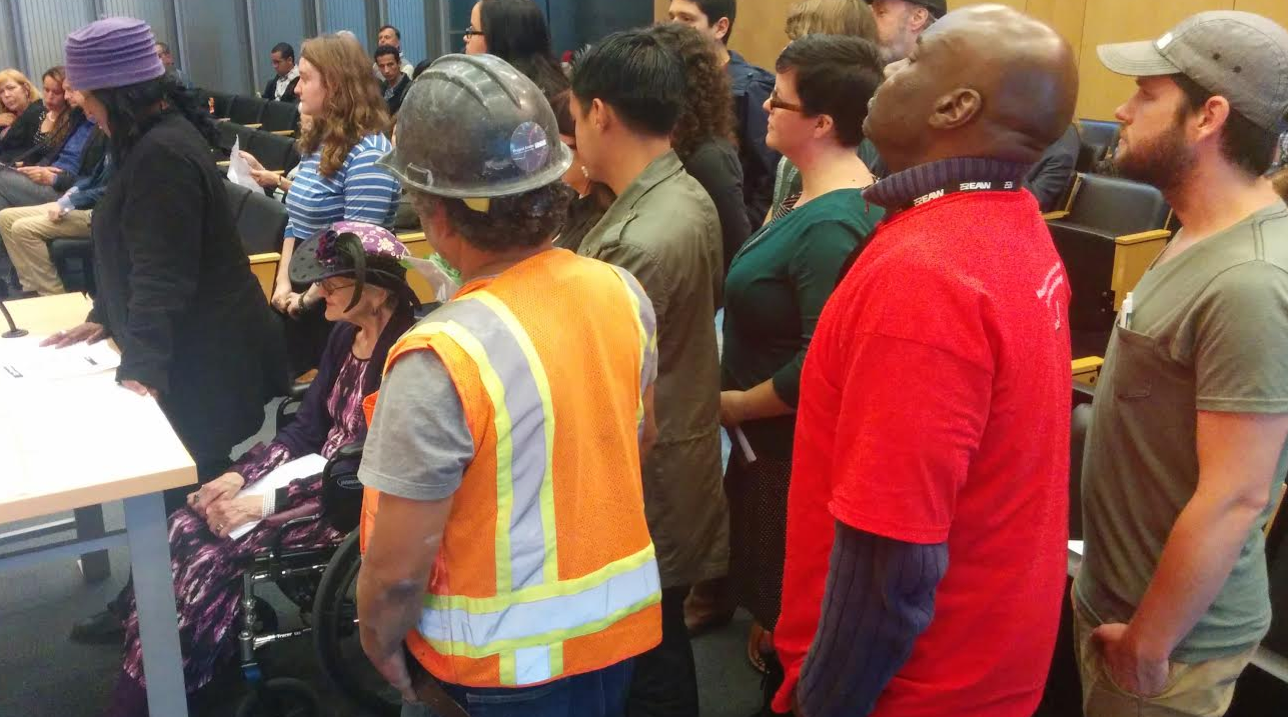
This is ready-made for the proposal the Reset Seattle coalition is working to implement. Reset Seattle is an alliance of hundreds of individuals and more than 30 faith, community, and labor groups in Seattle dedicated to stopping the foreclosure crisis.
The Bank of America settlement money could create a revolving loan fund that is designed purchase underwater homes in zip codes that are particularly hard hit – such as those in southeast Seattle where 15 -20 percent of homes are underwater and homeowners haven’t felt the recovery the way parts of the city have.
Seattle must seize this opportunity to demand Chase, Bank of America and Citibank meet their settlement obligations by funding principal reduction proposals, like the one proposed in Seattle. This seems like a perfect fit for everyone – the banks meet their obligations, the city doesn’t have to issue bonds to capitalize the program and underwater homeowners in the city get their principal reduced saving hundreds of dollars every month.
In her latest brief on principal reduction, Alliance Policy Associate Allyson Fredericksen writes that “many other cities are already taking action to give banks the incentive to renegotiate mortgages and work with homeowners to avoid foreclosure”
Some of those incentives, according to Fredericksen, include instituting fees to encourage mediation, to issuing fines for blight on foreclosed homes, to releasing reports on banks’ actions in the community. Such actions put the responsibility on banks to act without putting additional pressure on homeowners.
Seattle should learn from other cities, and lead the way in helping homeowners, without requiring those stretched and stressed homeowners to negotiate with banks on their own.
Unfortunately as we’ve seen time and again since the housing market collapsed, common sense rarely wins out and unnecessary suffering is inflicted to score an ideological point. Hopefully the stars have finally aligned
You can read the Bank of America settlement here.
You can read the details of the Community Relief section here.
College is supposed to be the pathway to a better job and a better life, but for students across the country college is also the pathway to a life of debt.
Since 2008, states across the country have decreased their investment in higher education, with every state except for Alaska and North Dakota providing less per student in 2014 than in 2008. These cuts have led colleges and universities to increase tuition to make up for the lost funding, shifting that burden onto students and their families.
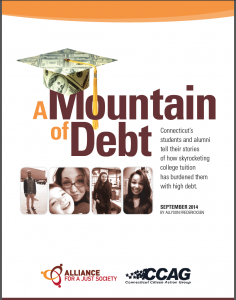
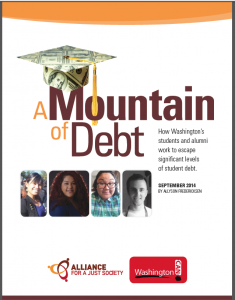
“A Mountain of Debt,” released this week in Washington and Connecticut, show clearly that when students face increased tuition and low wages, many must turn to student loans to cover costs. In fact, nationwide 70 percent of students graduate with student loans. The average amount of debt at graduation is $29,000.
Students in states like Washington and Connecticut find themselves unable to get by without loans for college, and unable to easily pay them off after graduation.
“I was working 80 hours a week to pay for school and living expenses. My average day would include working multiple fast food jobs sporadically thrown between classes, working one job until 8:30 at night, working 10 p.m. until 4 a.m. loading trucks in a factory, then getting up for class at 8 a.m. and doing it all over again,” said Alex Katz, a student at the University of Connecticut.
Christina Hoadley, a student at Central Connecticut State University, works two jobs to help pay for college, but still is worried about the prospect of paying off her loans. “After grad school, I anticipate walking away with a loan amount to the tune of $40,000. I’ll have to begin paying on all that within 6 to 8 months after completing school. It’s a lot of stress knowing the huge weight of debt that lies ahead.”
In Washington, Roxana Pardo Garcia loves the work that she has found since graduation, but she does not earn enough to make paying off her student loans easy. “My current student loan debt load is $19,000, and my loan payments take about 20 percent of my monthly take-home pay. I just wish I could help my mom out more. After all, she is the reason I went to school: to lift us out of the cycle of poverty.”
Bernadette Binalangbang of Tukwila, Washington has had to take a job outside of her field just so she can work to pay off her student loans. “I really love to bake and making pastries is my passion, [but] I’m currently employed full-time at a medical lab. It’s a complete shift from what I’d like to be doing, but it pays my bills and keeps me afloat — just barely. My student debt payments take up more than 30 percent of my monthly income.”
Disinvestment by states has left students and graduates like Alex, Christina, Roxana, and Bernadette in an uphill battle against the mountain of debt they’ve accumulated. States like Washington and Connecticut need to reinvest in higher education, or even more students will find themselves with no choice but to take out loans that they will repay for years to come.
This article by LeeAnn Hall, executive director of Alliance for a Just Society, was originally published in Huffington Post.
Is your state refusing to expand Medicaid? If so, it could be putting your health at risk, whether you’d qualify for Medicaid or not.
That’s because the Affordable Care Act (ACA) – the health reform bill — is about more than covering the uninsured. It’s also designed to strengthen the health care system for everyone. As a major source of health system funding, Medicaid – which covers low-income families, seniors, and people with disabilities — is a key part of that effort. You may not need Medicaid, but your hospital sure does.
As passed by Congress, the ACA made Medicaid expansion automatic. This expansion was slated to reach up to 15 million newly eligible working poor and near-poor adults and an additional 4 million who were previously eligible, but had not enrolled, injecting much-needed dollars into hospitals that had seen finances strained with growing uninsured rates.
However, when the Supreme Court ruled on the ACA in June 2012 it allowed states to opt out of expansion. With a stroke of the pen, the Court drove a gaping hole through health reform. Medicaid expansion would no longer be guaranteed across-the-board – it would now be the victim of contentious health-reform politics.
This decision proved disastrous for the families who had counted on Medicaid expansion for coverage and now find themselves in a terrible Catch-22. They earn too much for the meager Medicaid programs in states that have refused expansion. But, they also don’t make enough for coverage on the new health exchanges.
Yet these working-poor families aren’t the only victims of Medicaid expansion politics – hospitals and clinics are, too.
The costs of refusing Medicaid are staggering. Non-expansion states are passing up $423.6 billion in health care funds from 2013 through 2022. From 2014 through 2016, accepting Medicaid expansion would have provided $88 billion in health care funds. That’s $88 billion hospitals sorely need.
Meanwhile, the 27 expansion states will bring in an estimated $83.6 billion in additional health care funds.
Refusing Medicaid dollars is also a bad fiscal decision for states. That’s because the federal government will fully fund the expansion through 2016, with a gradual decrease over the next few years. Beginning in 2020, the federal government will provide 90 percent of funding — a matching rate that any investor would love.
The sad irony is that residents of opt-out states are contributing to the expansion through their taxes even if they can’t benefit from it. Meanwhile, residents of expanding states are seeing the investment in health care pay off.
Already, according to health-care rating agency Fitch Ratings, nonprofit hospitals and health care systems in expanding states are seeing benefits. Conversely, there’s already been a negative impact on hospitals in non-expanding states. This squeeze on hospitals is felt by all their patients.
The divergence between Medicaid-expansion states and refusing states will only grow. Under the ACA, the federal government is scheduled to scale back subsidies to hospitals with many low-income patients and high uncompensated care costs.
With automatic Medicaid expansion, the reduction in these “disproportionate share hospital payments” would have been offset by coverage gains — the hospitals wouldn’t need subsidies for the uninsured because almost everyone would be covered.
States that opt out of expansion are putting their hospitals at a double disadvantage.
There’s no reason to allow politicians to play these kinds of games with our hospitals and clinics. We should stand together to demand that the promise of Medicaid expansion — and a strong health care system — become reality in each of our fifty states.
Follow LeeAnn Hall on Twitter: www.twitter.com/LeeAnn_Hall
It’s a familiar scene.
One parent takes their children into a restaurant to use the restroom while the other parent waits outside. It’s been done by many of us — as parents, aunties, uncles, siblings. When kids have to go, they have to go.
But on July 19 this year, this simple and innocent scenario ended with the arrest and brutalization of one of the parents.
Absurd and humiliating acts of police overreach have also become familiar in this country. There are countless incidents of false arrest, harassment and use of force against innocent victims by the police every day in the U.S. The cases that end in loss of life garner headlines (sometimes), but mostly we don’t hear of the seemingly minor and mundane cases, unless they happen to us or to our family and friends.
But this time, the police picked on the wrong person.
Chaumtoli Huq, a well-respected human rights lawyer who is on a leave of absence as general counsel for New York City’s office of Public Advocate, was arrested in the middle of Times Square (a place often filled with tens of thousands of people standing in public) for, it seems, simply standing in public.
Standing in public and being South Asian and Muslim that is.
Huq — who was born in Bangladesh — and her family, had attended a rally in support of Palestinian rights that day. Then they took the young kids to the restroom at Ruby Tuesday nearby. Even though she was standing “inches” from the restaurant windows, police told Huq to clear the sidewalk. Huq said, “I’m not in anybody’s way. Why do I have to move? What’s the problem?”
That’s when police grabbed Huq and slammed her against the wall. She called for help and stated out loud, “I am not resisting arrest.” Police twisted her arm behind her back and handcuffed her. The officers rifled through her purse without probable cause. The police arrested her and took her away before her family even returned from the restroom.
To make matters worse, when Huq’s husband went to the jail, he aroused suspicion from police because he had a different last name than his wife. “In America wives take the names of their husbands,” the officer said.
Well then. What year is this again?
According to DNAInfo, Huq “was held for more than nine hours in lockup before being arraigned in Manhattan Criminal Court on charges of obstructing governmental administration, resisting arrest and disorderly conduct, court records show.”
Huq and her family have subsequently filed a complaint with the New York Police Department’s Civilian Complaint Review Board. They are also suing the NYPD and the City of New York in Federal Court for violating her civil rights, charging the police used “unreasonable and wholly unprovoked force” and claiming the arrest was part of a pattern of harassment of people of color in the city.
Huq told New York Daily News “I was hesitant to bring a case. My job is to be behind the scenes, and help all New Yorkers,” she said. But she realized “that I can use what happened to me to raise awareness about overpolicing in communities of color. I want there to be a dialogue on policing and community relations,” she said.
Let’s hope that conversation is one good outcome of this terrible and avoidable incident.
At the Alliance for a Just Society we speak of the criminalization of everyday life. Perhaps nothing demonstrates that reality more than an innocent mom being arrested for standing still on the sidewalk.


PHOTOS: © Charles Meacham Used with permission.
On the heels of the historic passage of Seattle’s $15 minimum wage, a King County Council committee will be voting next week on a living wage ordinance that would apply to county employees and contractors for broader King County.
The Alliance testified at a Council committee hearing on Sept. 2 calling for adoption of the legislation, which cites Alliance living wage data. King County has 2 million residents and includes the city of Seattle.Continue reading “King County Living Wage Ordinance a Modest Step to Address Inequalities”
Education is supposed to be a ticket to a better future. Every day, people see ads from for-profit colleges offering programs that promise to lead to a career as a dental assistant, respiratory therapist, auto mechanic, and more. Seeking a better life for themselves and their families, many people enroll in these schools – only to find out the graduation and job placement rates were greatly overstated – and now they are burdened with expensive loans.
Instead of building a career, many students are deeper in debt, and still without a job.
One of the strongest examples of these tactics is also one of the largest for-profit universities in the country, Corinthian Colleges, based in Orange County, California. After years of facing down lawsuits over the quality of its courses and inflated employment rates for recent graduates, Corinthian Colleges was shut down by the U.S. Department of Education at the end of June.
Many of the schools operated by Corinthian have familiar names: Bryman School, Everest, Heald College and many other throughout the country.
In addition to the lawsuits, Corinthian students also have one of the highest loan-default rates in the country. While Corinthian Is one of the most notorious, they are not unique in the for-profit college industry.
Students graduating from for-profit schools leave with more debt, yet make less money and are less likely to have a job than students at non-profit and public institutions. Most don’t even make it to graduation – the average time spent enrolled at a for-profit school is just 4 months.
Yet, 96 percent of for-profit college students take out loans to finance their education, compared to about half of those attending a public or non-profit college. Dropping out leaves many students even worse off than before – with no degree, but stuck with loans to pay off.
For-profit college students are only 13 percent of all students enrolled in higher education, however, they make up half of student loan defaults.
For-profit colleges also heavily recruit exactly the people who perhaps wouldn’t pursue higher education, particularly low-income, minority, and first-generation students. Internal documents from Corinthian Colleges described their target students as “isolated,” “impatient,” individuals with “low self-esteem,” who have “few people in their lives who care about them” and who are “stuck” and “unable to see and plan well for future.”
When enrolling, students are regularly misled by inaccurately high employment and graduation rates. For-profits also charge a lot more than similar public or community colleges for the same programs. This lets the college profit off both the loans the student takes out and the huge amounts of federal aid available for low-income students. Again, even though they only enroll 13 percent of students, they’re receiving 32 percent of federal Pell grants for low-income students.
Lawsuits accusing for-profit colleges of lies and fraud pop up over and over again, but almost every time the companies manage to settle out of court. This allows them to claim that legally, they haven’t been found in the wrong, and they can keep raking in money from students and taxpayers. Corinthian Colleges was sued in 2007 by the State of California, but settled out of court – and continued with the exact same illegal, misleading tactics for another seven years.
Students nationwide are struggling with the ever-increasing cost of college at public and private nonprofit schools. The financial aid that’s currently being funneled from the federal government to the pockets of CEOs and shareholders could instead be spent on supporting students in programs that provide a decent education.
The Obama administration is working to prevent colleges that aren’t producing good outcomes for their students from receiving federal aid money, something the for-profit college industry is fighting aggressively – lobbying against new, improved regulation.
Stronger regulations on which programs get federal aid money would be a better use of scarce financial aid dollars and would produce better outcomes for students and communities. Let’s hope stronger regulations go into effect soon – before more students get swindled.
An open letter from more than 1,000 business owners throughout the country was published as a full-page advertisement in The Hill today, calling on the president not to delay executive action on immigration.
For Immediate Release
Sept. 9, 2014
Contact: Kathy Mulady
Kathy@allianceforajustsociety.org
(206) 992-8787
Rep. Gutierrez Joins Small Business Owners in Calling for Executive Action on Immigration
Small business owners nationwide sign open letter to the president
An open letter from more than 1,000 business owners throughout the country was published as a full-page advertisement in The Hill today, calling on the president not to delay executive action on immigration.
The ad was sponsored by Main Street Alliance, a national organization of small businesses.
Businesses, communities and families suffer when politics takes precedence over people.
“We are asking for the president’s leadership because we don’t believe immigrant families should be used as a political football during election season,” said Amanda Ballantyne, national director of Main Street Alliance.
“It’s clear that elected leaders in D.C. don’t feel the urgency that our communities and small business owners are feeling. We can’t afford to have families living and working in the shadows – they must have an opportunity to contribute and prosper,” she said.
Rep. Luis Gutierrez (D-Illinois), spoke this morning on a conference call with reporters and small business owners from throughout the country.
“I am happy to join small business owners in calling on Washington to act on immigration reform and calling for the President to take executive action as soon as possible. Such action would unleash a torrent of economic activity in Chicago and across the country,” he said.
“Immigrants who are in constant fear of deportation or losing their family are less likely to spend on big purchases, less likely to buy a house over renting, or start a small business that employs others because it could all be taken away so quickly if they are deported,” said Gutierrez.
“While we fight for broader immigration reform, one thing the President can do is take immigrants who are the driving engines of small business corridors like 26th Street in Chicago, out of the deportation line. They are assets to our community, but we treat them like fugitives and that hurts all the rest of us in our wallets,” he said.
Small businesses on the call this morning included:
Makini Howell – Plum Restaurants; Seattle, Washington
Catherine Matthias – Stewart Jones Jewelry Design Studio and Art Gallery; Joseph, Oregon.
Martin Heroux – Armando y Jorges’ Orlandoan Hot Sauce; Orlando, Florida
Dan Shannon – Gary’s Auto Service; Denver, Colorado
Fausto Rodriguez – Woodside Medical Clinics; New York City
Joaquin Molina – Arcanum Electric Tattoo, Pueblo, Colorado
The open letter to the president, and a full list of all 1,000 signers can be seen here: http://mainstreetalliance.org/open-letter-relief/
# # #
Main Street Alliance, a program of the Alliance for a Just Society, is a national network of small business coalitions working to build a new voice for small businesses on important public policy issues. Alliance small business owners share a vision of public policies that work for business owners, employees, and the communities we serve.