Rigged to Fail – Press and Media Hits

Rigged to Fail

When State Policies Suppress Workers’ Abilities to Make Ends Meet
March 2015
http://thejobgap.org/


Low Wage Nation – Press and Media Hits

Low Wage Nation 

Nearly Half of New Jobs Don’t Pay Enough to Make Ends Meet 
Press and Media Hits
January 2015

Press Release:
“A Full-Time Job Should Lead to Financial Stability, Not to Poverty”

OREGON

FLORIDA

MONTANA

NEW YORK

MAINE

Blog Posts and Opinion Pieces

Job Gap Economic Prosperity Series
Selected Opinion Pieces and Blog Posts

Op-Ed: Tax The Big Businesses That Won’t Pay Connecticut Workers A Living Wage
By State Rep. Peter Tercyak
The Connecticut Mirror

Montana Working Families Deserve a Living Wage
State Sen. Sue Malek
The Montana Standard

Minimum Wage Shouldn’t Force Workers to Live in Poverty
By LeeAnn Hall
January 22, 2015
TruthOut

The Next Big Progressive Battle: A Living Wage
By LeeAnn Hall
January 25, 2015
Truth Out

Maine’s Workers Deserve More Than a Poverty Wage
Amy Halsted and LeeAnn Hall
March 18, 2015
Bangor Daily News

Let’s End Two-Tier Pay System
By LeeAnn Hall and Juana Donato
September 16, 2014
Albany Times Union

The ‘Secret Sauce’ That Could Kill a Minimum Wage Hike
LeeAnn Hall and Saru Jayaraman
April 17, 2014
The Capital Times

Revolving Door Slams on Minimum Wage Hike
By LeeAnn Hall and Saru Jayaraman
April 4, 2014
The Hill

Fast Food Workers Will Protest Again Today. Here’s What They’re Up Against|
Alliance for a Just Society
Apr. 3, 2014
Mother Jones

National Restaurant Association Doubling Down on Lobbying
Alliance for a Just Society
April 4, 2014
Politico

Working Families Need Good Jobs – Not Just Any Job
By Allyson Fredericksen
https://www.allianceforajustsociety.org/2015/02/working-families-need-good-jobs-not-just-any-job/

Low-Wage Job Growth a Major Factor in Income Inequality. Patience is Not the Answer.
By Ben Henry
https://www.allianceforajustsociety.org/2015/01/low-wage-job-growth-a-major-factor-in-income-inequality-patience-is-not-the-answer/

Testimony: A Living Wage Is about Family Prosperity
By Ben Henry
https://www.allianceforajustsociety.org/2014/12/testimony-a-living-wage-is-about-family-prosperity/

Making Ends Meet: The High Cost of Child Care
By Allyson Fredericksen
https://www.allianceforajustsociety.org/2014/12/making-ends-meet-the-high-cost-of-child-care/

Making Ends Meet: Unaffordable Housing
By Allyson Fredericksen
https://www.allianceforajustsociety.org/2015/01/making-ends-meet-unaffordable-housing/

Fair Wages Aren’t Enough, Workers Need Hours, Predictability, too
By Allyson Fredericksen
https://www.allianceforajustsociety.org/2014/08/minimum-wage-isnt-enough-workers-need-hours-predictability-too/

Who Earns a Living Wage, and Who Doesn’t?
By Allyson Fredericksen
https://www.allianceforajustsociety.org/category/research-policy/economic-justice/

Voter Support Spreading Nationwide for Higher Minimum Wage
By Allyson Fredericksen
https://www.allianceforajustsociety.org/2014/11/voter-support-spreading-nationwide-for-higher-minimum-wage/

Equity in the Balance – Press and Media Hits

Equity in the Balance

How a Living Wage Would Help Women and People of Color Make Ends Meet

November 2104

Press Releases:

Groundbreaking Report Reveals Evidence of Economic Racism

Only 52 percent of Full-Time Workers of Color Earn Enough to Make Ends Meet

Quotes about the report: 

Dr. Dorian Warren, associate professor of political science at Columbia University, calls the report “groundbreaking.”

“No one in the country is talking about economic racism – and here, in this report, are the numbers that clearly illustrate its existence and its impact,” Warren said. “When people talk about poverty, race has disappeared from the conversation. The economy and race have become uncoupled in our country.”

Saru Jayaraman, director of Restaurant Opportunities Centers United:

Equity in the Balance provides a stark national picture of what we’ve been seeing over the past decade in the restaurant industry, one of the largest private-sector employers in the nation. Women and people of color bear the brunt of the country’s growing income inequality gap.”

“Increasingly, the only jobs available to all people are low-wage jobs,” Jayaraman said. “The difference for women and people of color is that they are never able to move out of these jobs and into positions that will allow them to support their families.”

Families Out of Balance – Press and Media hits

Families Out of Balance

How a Living Wage Helps Working Families Move From Debt to Stability
August 2014

Press Release:

Families Out of Balance: Living Wages Move Families from Survive to Thrive

Media

Connecticut

“Working Families Struggling to Make Ends Meet are Sliding Deeper into Debt” – Connecticut Post Blog

“Campaign demands better job access” – Yale Daily News: New Haven, CT

“Op-Ed: Tax the big businesses that won’t pay Connecticut workers a living wage” – The Connecticut Mirror

“Report: Connecticut’s Living Wage Is $19.08 An Hour” – CTNewsJunkie: Connecticut

“Report: Connecticut’s living wage is $19.08 an hour” – Middletown Press News

Florida

“Gov. Scott’s definition of job growth is low-pay, dead-end” – The Palm BeachPost

“New report says minimum wage in Florida should be doubled to support working families” – Creative Loafing: Tampa, FL

“Report: Florida’s Minimum Wage Less Than Half What It Should Be” – WLRN Radio: Miami, FL

Idaho

“Study Says Idaho Living Wage is $14.50″ – KPVI TV: Pocatello, ID

“Study: Idaho’s minimum wage half of livable wage” – Lewiston Tribune: Lewiston, ID

“Idaho’s minimum wage only half of livable wage” – Idaho Statesman: Boise, ID

“Idaho’s minimum wage only half of livable wage” – Idaho State Journal: Pocatello, ID

“Idaho’s minimum wage only half of livable wage” – KBOI TV: Boise, ID

“Minimum Wage Only Half a Livable Wage for Idahoans” – Twin Falls Times-News: Twin Falls, ID

“Minimum wage doesn’t allow for living wage in North Idaho” – KHQ TV: Spokane

“Idaho’s minimum wage is half of living wage for 1 adult, group says” – Idaho Statesman: Boise, ID

“Idaho Families Can’t Make Ends Meet” – The Spokesman-Review, Spokane, WA

“$14.57: Idaho’s Living Wage” – Boise Weekly

“Families Out of Balance: Idaho’s Reality Is Nowhere Near Living Wage” – Boise Weekly

Maine

“Groups want minimum wage issue in campaigns” – WCSH TV: Portland, ME

“Report: Maine’s Minimum Wage Earners Falling Further Behind” – MPBN News:

“Report: Mainers on low wages face tougher times” – MaineBiz, Maine’s Business News Source

“New living wage report: Maine families struggle to make ends meet” – Maine Insights

“Maine’s Working Families Deserve to Earn a Living Wage” – Maine Center for Economic Policy

“Mainers continue to struggle with low-paying jobs” – The Pulse Morning Show WZON Radio: Maine

Montana

“Montana working families deserve living wage, health care” – The Missoulian, Missoula, MT

“The cost of living in Montana” – Helena Independent Record

“Op-Ed: Montana working families deserve a living wage” – The Montana Standard

“Sen. Malek: Montana working families deserve a living wage” – Ravalli Republic

“The cost of living in Montana” – The Montana Standard

“Study shows living wage would provide stability for families” – NBC Montana

“Montana group advocating for workers to be paid a ‘living wage’” – KAJ18 TV: Kalispell, MT

“‘The Equality Of Opportunity’” – Montana Public Radio

“Local group advocating for workers to be paid a “living wage” – KPAX TV: Missoula, MT

Minimum wage isn’t a living wage in MT – The Missoulian

New York

“Report says state minimum wage leaves Ulster County families behind” – Daily Freeman: Kingston, NY

“NYS Senator, Others To Call For Minimum Wage Increase” – WAMC Northeast Public Radio

“Report says New York’s minimum wage leaves Ulster families behind” – Mid-Hudson News

Oregon

“Michelle Glass – Oregon Action” – KOBI TV: Medford, OR

“A living wage in Oregon? $15.96, says report” – Portland Business Journal: Portland, OR

“15th Annual Job Gap Report: Wages are Down and the Cost of Living is Up” – The Skanner: Portland, OR

Virginia

“Virginia families need higher wages, Medicaid expansion” – Augusta Free Press: Waynesboro, VA

Washington

“King County weighs mandatory living wage for contract employees next year” – Real Change News: Seattle, WA

“Report: Washington’s Low-Income Residents Are Disproportionately Burdened By Debt” – KPLU Radio: Seattle, WA

“The living wage in King County? Way more than $15 per hour” – Puget Sound Business Journal

“Getting Paid: Washington to raise its minimum wage” – Inlander, Spokane, WA

“King County Council Makes ‘Statement’ with Living Wage Vote” – Seattle Weekly

“King County Council approves ‘living wage’ requirement” – Seattle Times


20 Years Later, Can We Finally End Excessive Policing?

The movement against police violence — a movement perhaps best summed up by the slogan Black Lives Matter — is at a turning point.

Of course, police abuse of power is as old as policing itself. Racist and disproportionate police misconduct, and violence targeted at communities of color, is just as lasting. But it seems in recent months that something is happening that points to a major opportunity for real and lasting reform.

One clue to this shift happened in the past few weeks. Amid the physical and emotional rebuilding of Baltimore following the in-custody killing of Freddie Gray and the public protest and revolt that followed, Democratic presidential candidate Hillary Clinton gave her first policy speech of the campaign season. It was a call for comprehensive police reform.

Clinton didn’t just call for small reforms, but questioned the whole logic of current police practices – calling on Congress to, “end the era of mass incarceration.” Her remarks are also surprising because they are in stark contrast to the policies enacted by her husband, former president Bill Clinton, just two decades earlier.

Then-President Clinton signed into law the Violent Crime Control and Law Enforcement Act of 1994, which made three-strikes a federal law, expanded the number of violations subject to capital punishment, used block grant funding and a number of other sweeping measures that advanced criminalization of everyday life.

At the time, there were about 1 million people in the prison in the U.S. Now there is 2.3 million. The 1994 Crime Bill federalized “three-strikes” laws, massively expanded the number of death-penalty crimes, created whole new categories of crime for immigrants and suspected gang members, and put an additional 100,000 police on the street around the country. Mass incarceration became the law of the land.

While policing certainly wasn’t great for black communities before 1994, since then extreme and excessive policing has been encouraged through incentives, and Congress and the President changed policing as we knew it. The lost lives from Ferguson to Baltimore are only a small hint of the devastating results.

But Hillary Clinton is not the only mainstream figure to recently come out against current policing practices. A number of law enforcement officials have spoken publicly of late about persistent racial problems in police departments nationwide.

Significantly, last year just before announcing his resignation, former Attorney General Eric Holder (the country’s top cop mind you) — declared that, “for far too long – under well-intentioned policies designed to be ‘tough’ on criminals – our system has perpetuated a destructive cycle of poverty, criminality, and incarceration that has trapped countless people and weakened entire communities – particularly communities of color.”

Now even Bill Clinton is getting in on the act, saying his wife and presidential candidate should repeal the very laws he championed, saying, “We have too many people in jail.” The admission may be a little late, but it’s a welcome change. More importantly it marks an opportunity for organizers, activists, and all communities affected by these disastrously failed policies, to redefine safety and security and change policing as we have come to know it.

But it’s an opportunity that won’t last forever. The question is whether the movements are prepared to take advantage of the moment. It’s up to us.

Racial Disparities in Health Care Access Magnified As More Gain Coverage

I was recently on a telephone call with Antron McKay-West, the president and founder of Upgrade Mississippi. He was describing the frustration people in his tiny hometown on the Mississippi Delta experienced trying to sign up for health insurance under the Affordable Care Act.

Most families in the town still don’t have Internet in their homes; cellphone reception is unreliable, it comes and goes like the clouds blowing across the sky.

“It is so rural, most people can’t imagine life there,” said McKay-West. “Most people don’t have Internet, if they do, it’s very slow. It’s not the technology most people in bigger cities are used to these days.

“I know people who were trying to sign up for health care coverage, but they don’t have Internet at home, they don’t have email addresses. When they tried to sign up by telephone, the assistants on the other end often told them to just go to the library and use the Internet there to sign up and check their email.

“In the neighborhood where I grew up, the library is 15 miles away,” said McKay-West.

His story illustrates just one of the many challenges we have in bringing health insurance — and then quality health care — to all people and all communities across the country.

As more people gain health insurance, unless we take concerted action to tackle glaring racial disparities in access to health care, those disparities will only be magnified.

In a new report “Breaking Barriers: Improving health insurance enrollment and access to health care,” author and researcher Gary Delgado provides plentiful evidence that the doors to quality health care are still closed to many people of color, families in rural communities, the poor, and those with language and cultural barriers.

Delgado, a visiting scholar at the University of California, Berkeley’s Institute of Social Change and a longtime civil and human rights leader, led a team that surveyed 1,200 low-income people in 10 states in Spanish, Cantonese and English. The report was released by the Alliance for a Just Society.

“Obamacare didn’t cause the widespread racial disparities we found, but neither did it solve them,” said Delgado. “We have a lot more work to do.”

There is progress. In late April, Montana Gov. Steve Bullock signed legislationaccepting federal funding for Medicaid expansion that will extend health insurance coverage to as many as 70,000 more people.

However, there are still 21 other states where legislators continue to turn their backs on people – about 3.8 million people – who fall into the Medicaid coverage gap, denying them access to affordable health insurance. These are people who earn too much to qualify for Medicaid, but not enough to qualify for ACA marketplace subsidies or afford premiums and deductibles on their own.

It’s even more insulting when you plot these 21 states on a map. More than half are states in the Deep South, the states of the Old Confederacy, where a disproportionate share of uninsured people are people of color, especially African American and Latino.

There is no other way to describe it than health care racism. Expanding Medicaid is just the first step toward ending it.

The struggle to access quality care continues even after people of color have health insurance, including the high costs of premiums and deductibles. Many people have never had health insurance, or maybe not for years, and have trouble getting clear information about what’s included in their coverage, such as preventive care, checkups and routine tests.

Insurance companies must also be held to their obligation for reducing racial health disparities, and increase transparency in their reporting of results.

In some communities, just finding a personal doctor within a reasonable distance of your home is difficult. Going to the doctor should be no more than a 30-minute trip. Even after enrollment, technology continues to be a barrier when insurance companies expect payments online or send important notices by email.

As the “Breaking Barriers” report recommends, innovative options like school-based health care and community clinics and have to be supported and encouraged, particularly in rural areas.

Medical-legal partnerships should be developed to address environmental factors that impact health, especially in low-income communities where issues like mold in housing and industrial toxins create serious health risks.

Delgado describes the Affordable Care Act as a new house built on an old foundation, using the old bricks. He’s right, we need a stronger foundation and more bricks. We also need to welcome everyone inside to enjoy the basic human right of quality, affordable health care.
This article was originally published by LeeAnn Hall in her Huffington Post column.

MEDIA: Breaking Barriers to Health Care Coverage and Access

NATIONAL

Study: Obamacare Hasn’t Solved Health Care Disparities, April 9, 2015 – U.S. News and World Report

Is ACA Serving Those Facing Barriers?  April 9, 2015 – Politico 

The PPACA and Health Care Disparities, 10 Things to Know, April 10, 2015 –Becker’s Hospital Review

Study: Your Health Could Depend on Where you Live, April 10, 2015 – New America Media

“Breaking Barriers” Research Uncovers Disparities in Health Care Access, April 10, 2015 – Milwaukee Community Journal

Obamacare Hasn’t Solved Health Care Disparities, April 10, 2015  – Gnomes News Service 

Difficulties People of Color Have Using Their New Health Insurance, April 17, 2015 ­– ThinkProgress 

What it Means for Your Health When Your State Refuses to Expand Medicaid, April 20, 2015 – AlterNet

What it Means for Your Health When your State Refuses to Expand Medicaid, April 22, 2015 – One Penny Sheet

Medicaid Limits, Internet Access Create Barriers to Obamacare, April 23, 2015 – National New Journal and Guide

Your Health Could Depend on Where You Live, April 16, 2015 – The Bay State Banner

Racial Disparities in Coverage, Care Persist, Despite ACA, April 13, 2015 – Fierce Health Payer

AFRICAN AMERICAN PRESS

Blacks Missing Out on Obamacare Savings, April 15 2015 – Greene County Democrat

Blacks Missing Out on “Obamacare” Savings, April 16, 2015 – The Los Angeles Sentinel

Blacks Missing Out on “Obamacare” Savings, April 16, 2015 (page 3) – Dallas Post Tribune

Blacks Missing Out on “Obamacare” Savings, April 15, 2015  – Bayou Buzz

Blacks Missing Out on “Obamacare” Savings, April 14, 2015  – Sacramento Observer

Blacks Missing Out on “Obamacare” Savings, April 18, 2015  – Real Times Media (Pittsburg)

Blacks Missing Out on “Obamacare” Savings, April 17, 2015  – The Seattle Medium 

Blacks Missing Out on “Obamacare” Savings, April 17, 2015  – The Atlanta Voice

CALIFORNIA

Health Care Racial Disparities Continue Despite ACA, April 8, 2015 – The Post News Group 

FLORIDA

Minority Report: New Study Indicates More Barriers Than You Thought To Health Care Access, March 24, 2015 –Orlando Weekly

F.I.R.E “Breaking Barriers” Study recommends Medicaid Expansion, March 24, 2015 – Orlando Politics

Breaking Barriers To Health Care Access In Florida, March 24, 2015 – The Florida Squeeze

IDAHO

Report Finds Low Income, Latino Idahoans Experience More Barriers to Health Care Access, April 2, 2015 – Boise State Public Radio (NPR)

Study: 78,000 Idahoans “Let Down” by Refusal to Expand Medicaid, April 2, 2015, – Boise Weekly

Report Finds That Low Income, Latino Idahoans Experience More Barriers in Health Care Access, April 2, 2015 – Hispanic Trending

MONTANA

Report shows disparity in health insurance, access to care for Native Americans, April 24, 2015 – The Missoulian

Report Shows Disparity in Insurance, Access to Care For Native Americans, April 24, 2015 ­ ­– The Helena Independent Record

Study Shows Health Care Disparities Among Minorities, April 23, 2015 – NBC Montana

Tribal Members Study “Breaking Barriers” Between Native Community, Health Care, April 23, 2015 – KPAX TV Ch. 8

Report shows disparity in health insurance, access to care for Native Americans, April 24, 2015 – Billings Gazette


LeeAnn Hall: Moving From Rage to Reform

Police violence is a national problem, and everybody has a stake in solving it

Another city has erupted in rage in response to a police killing.

After a week of peaceful protests following the death of Freddie Gray in Baltimore, “Charm City” was in flames. The authorities declared a state of emergency and deployed the National Guard.

In less than a year since the killing of Michael Brown by a Ferguson, Missouri police officer, numerous cases of police beatings, shootings, and killings of unarmed civilians — from New York to South Carolina, and from California to Baltimore — have grabbed the public’s attention.

Even white people like myself who identify with the “Black Lives Matter” slogan — the phrase that’s come to represent the movement against police violence — are stunned and emotionally drained by the almost daily reports of senseless killing and police brutality.

We’re tempted to turn away. But we can’t, because this issue is here to stay.

While we all condemn acts of violence, we must try to dig a little deeper to understand what’s happened in Baltimore and around the country. And we all have a responsibility to be a part of the solution — to channel this rage into real reform of the police.

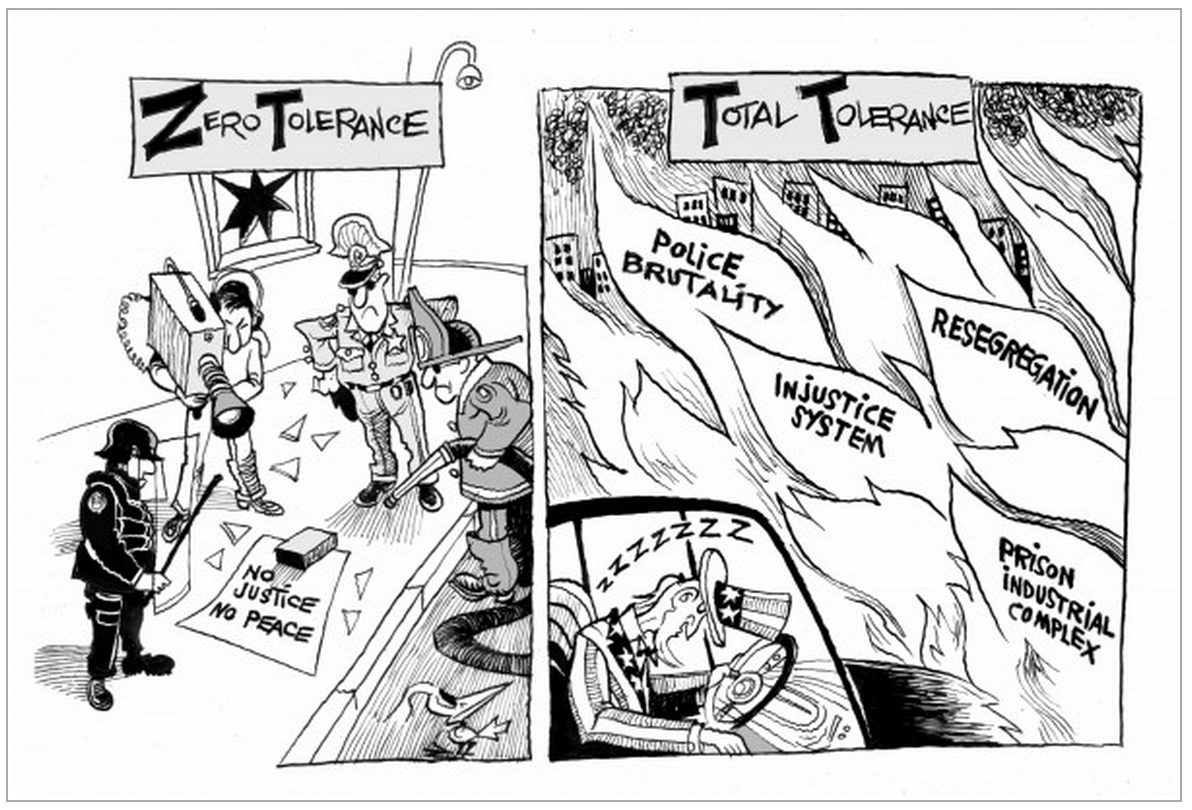
Baltimore is wracked by pervasive poverty, racial segregation, and crime — a grim reality popularized for the rest of the country by the HBO drama The Wire. One in four families in the city live in poverty, nearly double the national rate.Zero tolerance total tolerance jpeg

Baltimore is also troubled by a long history of police misconduct and violence against its residents. According to The Baltimore Sun, the city has paid $5.7 million in settlementsfrom police-brutality cases since 2011.

That history helps explain the explosive reaction by a small number of people to Freddie Gray’s alleged murder by six cops charged in his death.

Gray died after having his spine severed while in police custody — without any clear reason for his arrest. Deaths like his are all too common. And police are almost never held accountable.

This time, however, the state of Maryland has leveled charges against the officers involved, ranging from false imprisonment to assault to second-degree murder. That prompted celebrations in Baltimore, but further clashes are all but certain without real reform.

What else can be done? A few things come to mind:

Racialized police practices like stop-and-frisk and “zero tolerance” policing must end in Baltimore and across the nation.

Cities should adopt alternatives to jails and prisons for nonviolent crimes. Programs like Law Enforcement Assisted Diversion (LEAD) in Seattle have proven effective in reducing recidivism by diverting low-level drug offenders to rehab instead of prison.

Other communities have found restorative justice effective, involving offenders in the process of repairing any harm they may have caused.

Most importantly, governments must follow the example set in Baltimore in the wake of Gray’s killing. All police officers must be held accountable for abuses such as beatings, killings, and corruption.

Many critics of Baltimore’s uprising have invoked Martin Luther King Jr.’s appeals to nonviolence. But don’t forget King’s other essential reminder: “A riot is the language of the unheard.”

The only way to show that our country has heard the anger and sorrow of black communities is to end impunity for police officers who commit acts of brutality. This isn’t a Baltimore problem or a Ferguson problem or a black problem.

It’s a national problem, and everyone has a stake in solving it.

Harsh policing and more prisons haven’t reduced crime or solved the problems of our communities. The only way to avoid another Baltimore is to overhaul standard police practices across the nation.

LeeAnn Hall is the executive director of Alliance for a Just Society, a national research, policy, and organizing network striving for economic and social equity. AllianceforaJustSociety.org
Distributed by OtherWords.org